A voice AI concierge with the poise of a maître d'.
Atlas is a voice AI concept for luxury hospitality. Built for the Soho Houses, the Eden Rocks, the private villas. Two surfaces designed end to end: the guest-facing voice that takes the request, and the operator console where the host approves it. Brand, product, motion.
Premium hospitality lives or dies on staff time. Most of it goes to the routine.
A Soho House host, a villa concierge, a five-star reception. Their job is the relationship, the recognition, the memory. What they actually do most days is take dinner reservations, route a champagne order, confirm a late checkout, book a car.
The 80% that's routine eats the time that should be on the 20% that builds loyalty. Atlas is the design proposal: a voice AI that takes the routine, and an operator console where the host stays in the room as the final call.
The constraint that drove every decision: it has to feel like luxury, not technology. A guest never thinks they are talking to a system. A host never feels replaced by one.
"AI that augments the maître d'. Never one that replaces them."
Luxury over tech.
Every voice AI on the market looks like a tech product. Pastel gradients, friendly san-serif, a chat bubble. Wrong register for a room with a marble bar.
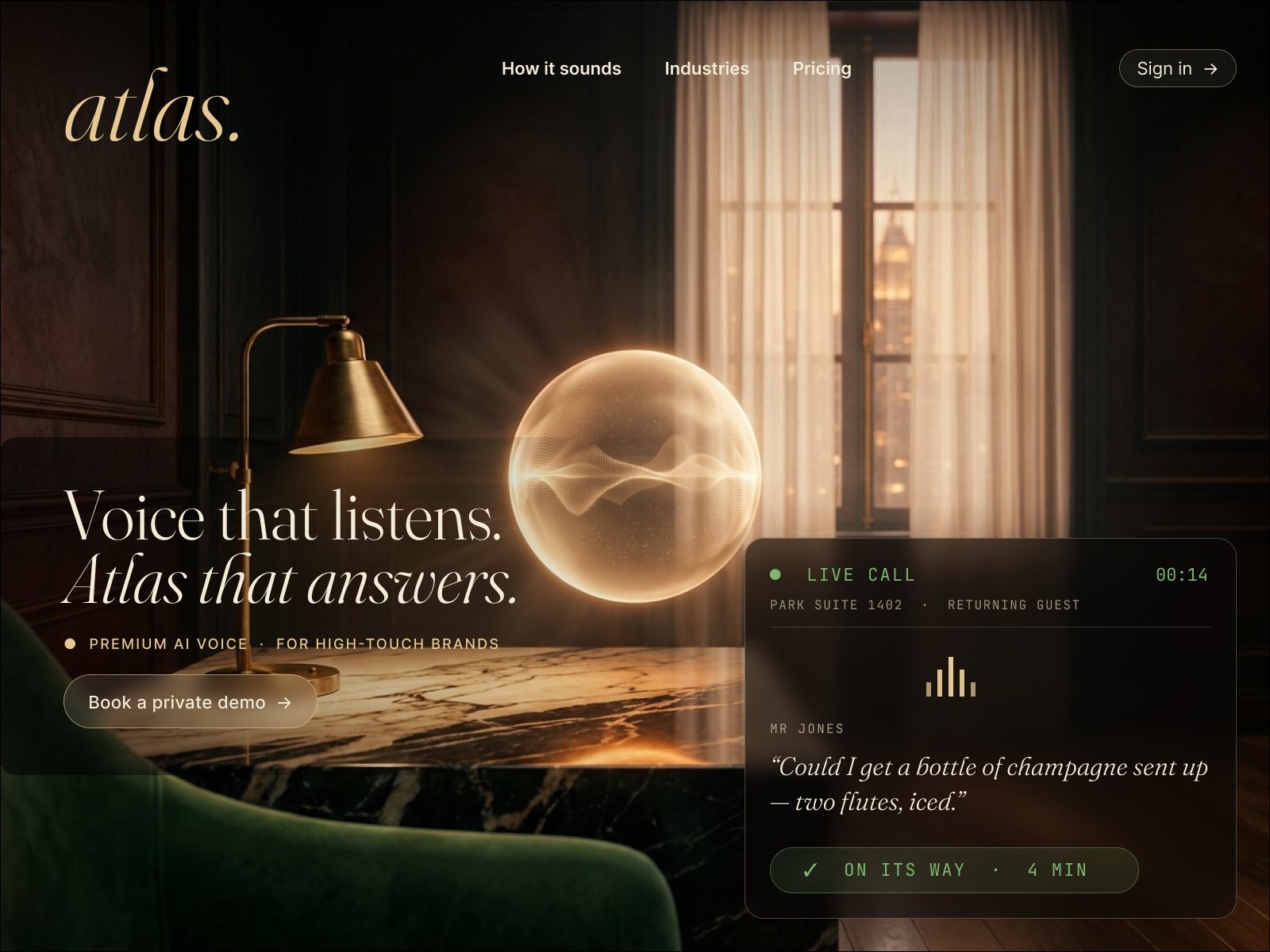
Atlas leans the other way. Editorial italic wordmark in Cormorant Garamond. A warm-dark palette pulled from a candlelit suite. Brass gold as the only accent. The orb is the brand mark, the product mark, and the live state, all in one: it breathes when the room is still, becomes a waveform when the guest speaks.
The guest never sees a chat. They hear a room.
The voice surface is a single screen. A candlelit suite, the orb glowing on a marble surface, the wordmark in italic above. When the guest speaks, the orb becomes a live waveform. A "Live call" card resolves alongside, transcribing the request in plain English: "Could I get a bottle of champagne sent up, two flutes, iced." The status returns just as quietly: "On its way. 4 min."
The room never breaks character. No chat bubble, no progress bar, no robotic "I've added that to your order." Service, not interface.
Everything Atlas heard. What the host still owns.
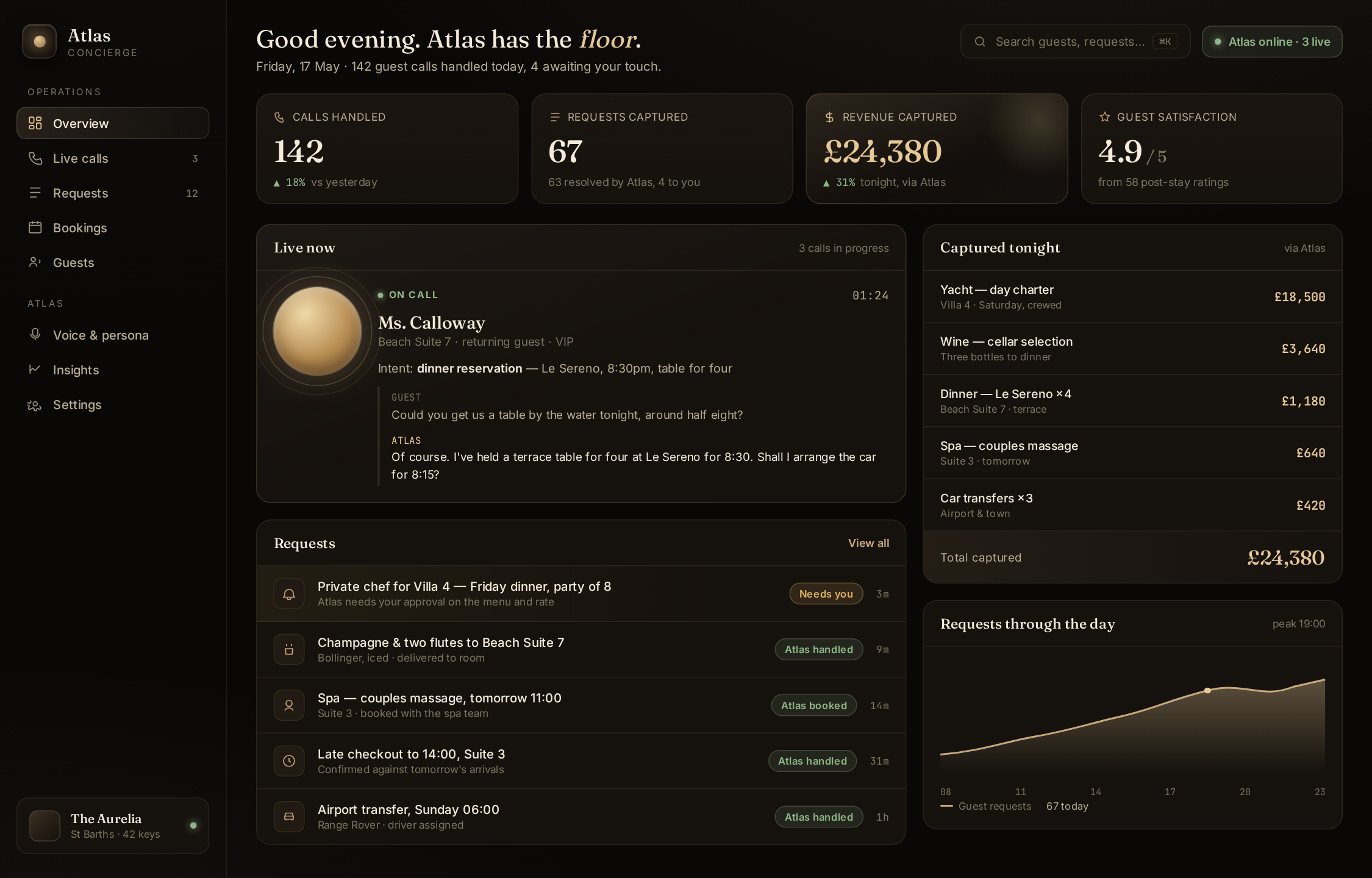
The dashboard is where the host lives. "Good evening. Atlas has the floor." sets the register immediately. Above the fold: how many calls handled today, how many requests routed, how much revenue Atlas captured, current guest satisfaction.
Below, the live call panel for active intervention. The host can listen, take over, or approve. The captured-tonight ledger lists every monetised request line by line. A queue of incoming requests, each tagged by what Atlas can handle alone and what needs the host. A day curve so the host can see the volume hitting them.
Designing for hospitality changes the bar.
Every other AI product I've worked on optimised for the user being efficient. Atlas optimises for the user feeling cared for. That's a different design language and it pulled the whole project somewhere I wouldn't have got otherwise.
The motion piece, the brand register, the operator console. They only work if you trust the room is more important than the system. That's the discipline I want to bring into the next product brief.

I'm Ishmael. A London designer who ships.
Seven years shipping interfaces, websites and brand systems. The last two running CoverTurn, the studio I founded in 2024. Brand, interface, production code, deploy. I own delivery end to end.
Talking to teams now: agencies, product companies, founders. Bringing the same hands inside the brief. Embedded retainer, founding designer, design engineer. Open to the right shape.
UK time · open to US overlap · available now
Background: A View at Hampstead with Stormy Weather, John Constable, ca. 1830. Yale Center for British Art, Paul Mellon Collection. Public Domain · CC0.